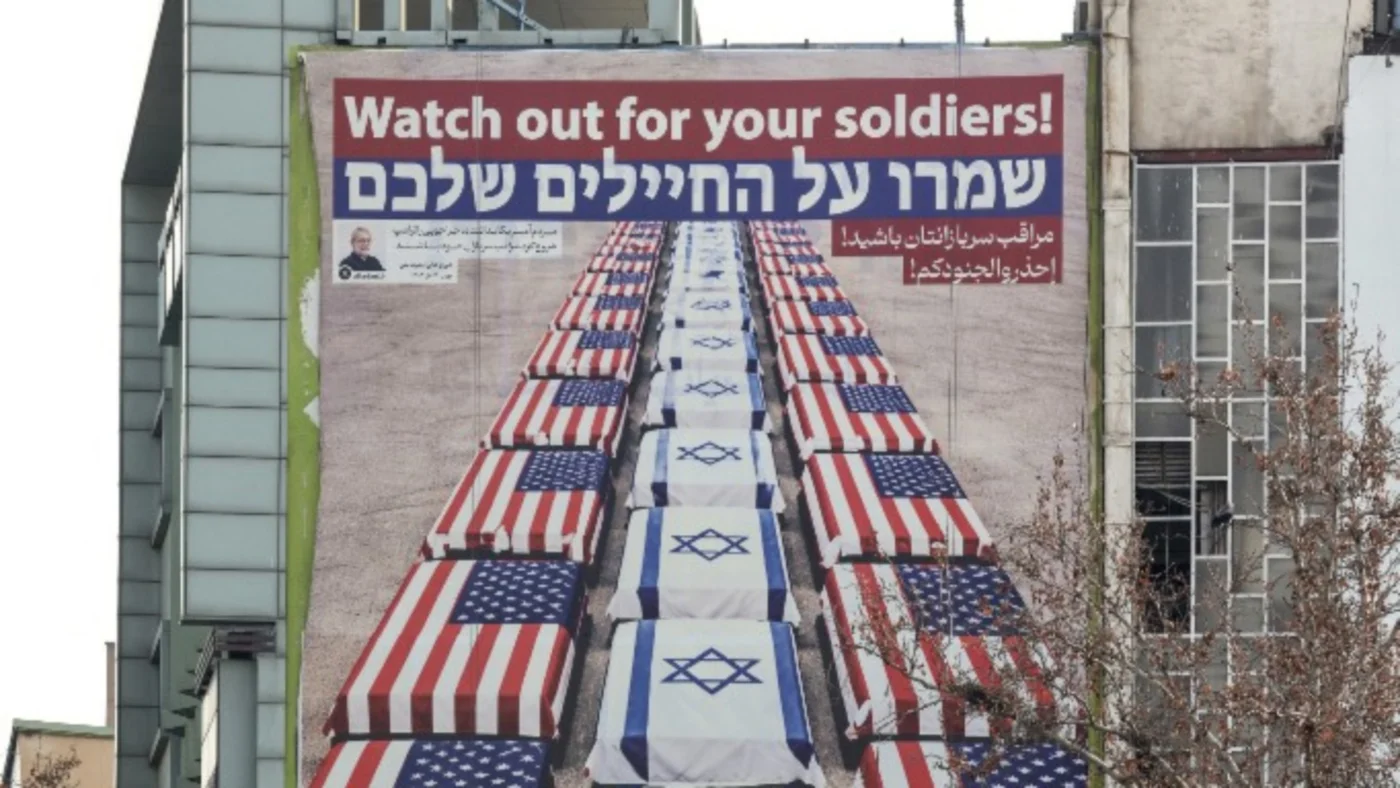
Everyone in the region, whatever their past history with the Islamic Republic, should do their utmost to defend Iran and guarantee its sovereignty
Barely a week has passed since US President Donald Trump waved his signature to the cameras at Davos on a charter for his so-called Board of Peace, and the Middle East is on a knife edge over the very real possibility of a third Gulf War.
It’s a familiar feeling. The USS Abraham Lincoln carrier strike group arrived within striking range of Iran on Sunday. F-15E Strike Eagles and B-52 bombers have been sent to Jordan and Qatar respectively.
Israel’s Channel 13 reported that the US military was preparing to reinforce its ground-based defences as well, with a Thaad air-defence battery expected to arrive in the coming days.
Israeli media have also been hard at work. Israel Hayom, the daily closest to the Israeli government, reported that Jordan, the UAE and the UK would provide logistical and intelligence support to the US military in the event of an attack.
This spurred the UAE to say publicly that it was committed “to not allowing its airspace, territory, or waters to be used in any hostile military actions against Iran… We affirm our commitment to not providing any logistical support to any hostile military action against Iran.”
New MEE newsletter: Jerusalem Dispatch
Sign up to get the latest insights and analysis on Israel-Palestine, alongside Turkey Unpacked and other MEE newsletters
This will be disregarded by Iran, whose senior officials have warned that the UAE has already gone too far. In the event of another attack, the Islamic Republic would not limit its retaliation to Israel and US military bases alone.
A senior Iranian official claimed to me last year that Israel was using Azerbaijan and the UAE in its dirty war against Iran. “We are definitely expecting another round of this war, and this time Iran will not be taken by surprise nor be on the defensive. It will go on the offensive,” he said.
“The UAE is going to pay a huge price. The next time we are attacked, it will spill over into the Gulf and the region.”
Targeting Khamenei
When Israel and the US attacked Iran last June, in a war that lasted 12 days, Tehran was misled by a forthcoming round of talks in Oman into believing that Israel would not strike before then.
At the time, the White House dismissed the notion that regime change was an objective of the strikes, which targeted senior military commanders, nuclear scientists, and the deep bunkers housing Iran’s uranium enrichment centrifuges.
Israeli Prime Minister Benjamin Netanyahu, however, wanted regime change. He said that assassinating Iranian Supreme Leader Ayatollah Ali Khamenei was “not going to escalate the conflict, it’s going to end the conflict”.
To create the conditions for their despair, and then use it as a casus belli against the country as a whole, is nothing new for the Mossad, the CIA or MI6
But the White House parted company. Axios reported that Trump was more reluctant than Netanyahu to target Khamenei. A senior administration official said: “It’s the ayatollah you know versus the ayatollah you don’t know.”
This time, however, that reticence has gone. The supreme leader will be the primary target.
Thousands of people were killed in the recent suppression of protests in Iran. How many is a matter of hot dispute. The Iranian government last week put the death toll at just over 3,100, while the Wall Street Journal has cited estimates from human rights groups putting the number closer to 10,000.
The uprising started in December as a protest by merchants in Tehran decrying the collapse of the rial and soaring living costs. The movement rapidly spread to other cities and poorer working-class neighbourhoods, in a clear sign of nationwide fury and despair after decades of US sanctions, corruption and mismanagement.
The same happened several years ago after the death in custody of Mahsa Amini, a 22-year-old Iranian Kurdish woman arrested by Iran’s “morality police” for not complying with the Islamic dress code.
But the fact that this rage against economic stagnation, experienced by the middle and working classes alike, was and is genuine, does not preclude the involvement of western and Israeli intelligence agencies in stoking the fire. The two are not mutually exclusive.
Maximum pressure
Iran’s deep economic crisis is the result of both internal state mismanagement, and the crippling sanctions imposed by Trump, who in his first term withdrew the US from the Iran nuclear deal and imposed a “maximum pressure” policy that was continued by the Democratic Biden administration.
Like the genocide in Gaza, attempting to bring Iran’s economy to its knees is a bipartisan policy. The primary victims of this policy are the Iranian people for whom the West claims to be so concerned.
To create the conditions for their despair, and then use it as a casus belli against the country as a whole, is nothing new for the Mossad, the CIA or MI6 – nor is actively trying to turn an economic protest into an armed insurrection. What is different this time around is that little or no attempt was made to hide their fingerprints.
Iran protests: Are viral atrocity numbers part of a march to war?
The Mossad made no bones about its involvement. In a Farsi-language post on X (formerly Twitter) on 29 December, it encouraged Iranians to protest, even saying it was physically with them at the demonstrations.
“Go out together into the streets. The time has come,” the Mossad wrote. “We are with you. Not only from a distance and verbally. We are with you in the field.”
This alone might account for the high number of police deaths. Iranian Foreign Minister Abbas Araghchi accused Israeli-affiliated networks of infiltrating the protests, engaging in sabotage and targeted attacks to escalate clashes and increase casualties.
Israel’s strategy failed when tens of thousands of people held a pro-government rally, the internet was shut down, and thousands were arrested – but not before the idea had been planted in western media that toppling the regime was now an international human rights cause, and that anti-regime factions had a potential leader in Reza Pahlavi, the 65-year-old son of Iran’s last shah.
Trump pointedly refused to meet Pahlavi. Asked by podcast host Hugh Hewitt if he would meet the US-based Pahlavi, Trump said: “I’ve watched him, and he seems like a nice person. But I’m not sure that it would be appropriate at this point to do that as president.”
This was interpreted as a Venezuela-style message that if Trump got rid of Khamenei, he would be prepared to do a deal with the surviving administration.
Change of heart
We have gone down this path many times before. But this time around, there is a significant difference from previous attempts to bring down the Islamic Republic.
The Sunni Arab world – which for so long had felt itself to be a target of the expansion of Iran’s network of armed groups which, at times, fought bitter proxy wars across Iraq, Lebanon, Yemen and Syria – is turning towards Iran.
Arab states, too, fear becoming victims of Israel’s policy of fragmenting nation states
This is not happening out of any romantic notion of supporting the Palestinian cause, nor because of a sudden attack of religious tolerance. Nor is this primarily about preserving oil assets, which are supremely vulnerable to retaliatory drones and missiles.
This change of heart is about the perception of the Arab national interests of sovereignty and independence. Iran is increasingly seen to be fighting the same battle that Arab states are waging against domination and occupation.
They, too, fear that Israel is on a path to become the region’s military hegemon, and that fragmenting neighbouring states is the quickest way to achieve this.
The most dramatic swing against Israel can be seen in Saudi Arabia, which has been for the past decade the bastion of anti-Iran scheming. On 6 October 2023, the day before the Hamas-led attack on southern Israel, Saudi Arabia was on the cusp of signing the Abraham Accords, by which the kingdom would have normalised relations with Israel.
Today, by contrast, not only is that move well and truly off the table, but a virulent campaign has been launched in the media against Israel.
‘Into the arms of Zionism’
One article in particular could have only been published and republished with approval from the very top.
Under any circumstances, the appearance of Saudi academic Ahmed bin Othman al-Tuwaijri in the columns section of the newspaper Al Jazirah should have raised eyebrows, as the media outlet is a government mouthpiece, and Tuwaijri himself has been more sympathetic to the banned Muslim Brotherhood.
For a government that has conducted several purges of Saudi academics and journalists linked to political Islam, Tuwaijri’s appearance is itself of note.
The newspaper published a scathing column in which Tuwaijri accused the UAE of throwing itself “into the arms of Zionism” and functioning as “Israel’s Trojan horse in the Arab world in the hope of being used against the Kingdom and major Arab countries – in betrayal of God, His Messenger and the entire nation”.
Tuwaijri rightly accused the UAE of fragmenting Libya, of “spreading chaos in Sudan” by funding and arming the Rapid Support Forces, and of “infiltrating Tunisia like vermin”.
He also claimed that the UAE was deliberately backing Ethiopia’s Grand Renaissance Dam project, despite the damage it could inflict on Nile water levels downstream and Egypt’s strategic interests.
All of this is true, but coming from Saudi Arabia, the UAE’s partner-in-crime in much of the counter-revolution that crushed the Arab Spring, this is strong stuff.
Abu Dhabi responded by activating its networks in DC. Barak Ravid from Axios wrote on X that the article was not only anti-Israel, but antisemitic.
Fighting Israel is now a matter of national pride in Syria, as it is across much of the region
The Anti-Defamation League (ADL) then weighed in, saying it was alarmed by “the increasing frequency and volume of prominent Saudi voices – analysts, journalists, and preachers – using openly antisemitic dog whistles and aggressively pushing anti-Abraham Accords rhetoric, often while peddling conspiracy theories about ‘Zionist plots’”.
No sooner had the furore over this column reached this intensity, than the article itself disappeared from the internet. The ADL claimed credit for this deletion by noting that it happened shortly after the group’s post appeared.
But this was not to be the last word on the column, which almost as suddenly reappeared on Al Jazirah’s website.
Columbuos, which is widely assumed to be the voice of Saud al-Qahtani, Crown Prince Mohammed bin Salman’s media tsar, posted on X: “Some of the people from the reconciled Emirates – may God reform them – are circulating a lie that the Saudi article about al-Tuwaijri was deleted from Al Jazirah! Out of fear for international relations! This is not true; the article is still there, and here is the link to the article.”
The only conclusion to be drawn from this affair is that what Tuwaijri said represents the official line of the kingdom itself.
Fragmentation policy
The Gaza effect is making itself felt across the region. Gaza itself was a military defeat for Hamas, Hezbollah and Iran. The Gaza effect, however, is anything but.
In crushing Gaza, Netanyahu has vowed repeatedly to reshape the Middle East. He has said on frequent occasions since that he is “changing the face of the Middle East” and that this conflict is a “war of rebirth”.
An integral part of Israel’s fragmentation policy was to make sure, after the fall of former President Bashar al-Assad, that Syria never re-emerged as a sovereign nation state.
This was Netanyahu’s intention when he launched the biggest bombing raid on Syria in the country’s history within hours of the fall of Assad in late 2024. Syria’s airforce and navy were destroyed in 24 hours.
An ever expanding Israel will pave the way for its demise
Israeli tanks then rolled into southern Syria on the pretext of establishing a protectorate for the Druze, an offer the Druze leadership initially rejected.
Israel also offered to “protect” the Kurds in the north of Syria. This offer proved spectacularly hollow last week, after clashes that started in Kurdish areas in Aleppo led to the dramatic collapse of the Syrian Democratic Forces (SDF), and to Damascus assuming control of most of Syria.
The SDF’s onetime backer, the US, did not lift a finger to stop the rout, and Israel did not respond to Kurdish pleas for help.
Before a ceasefire was signed, Tom Barrack, the US special envoy for Syria, accused SDF commander Mazloum Abdi of attempting to drag Israel into internal Syrian matters.
The region is indeed changing, but not as Netanyahu once imagined. Syria was exhausted after a decade of civil war when the Assad regime collapsed like a house of cards. Its new leader, President Ahmed al-Sharaa, bent over backwards to signal that he did not want a war with Israel.
A year on, the mood in Syria has been transformed by the aggression and arrogance of its Israeli occupiers, who not only have no intention of giving up the occupied Golan Heights, but whose forces are now within 25 kilometres of Damascus itself.
Lesson learned
Fighting Israel is now a matter of national pride in Syria, as it is across much of the region. Sharaa himself continues with the same caution and astuteness that he displayed when he ousted Assad.
On the cusp of victory in northern Syria, Sharaa issued a decree recognising Kurdish as a national language and restoring citizenship to all Kurdish Syrians.
New military pacts are in the offing. Israel refers to one as a Muslim Nato, but it is no such thing.
It is being formed by the growing realisation among the Muslim middle powers of the region that the only way of containing Israel is to come to each other’s defence. This is the lesson learned by seeing Israel pick off one enemy at a time.
The biggest regional army, Turkey, is currently in talks to join an existing mutual defence pact between Saudi Arabia and Pakistan. Turkey, Saudi Arabia and Egypt are now openly supporting Sudanese army chief Abdel Fattah al-Burhan.
And to further deepen the split with the UAE, Saudi Arabia is about to buy Sudanese gold, a move that would curtail but not end Abu Dhabi’s African gold trade.
These are all signs that the region is indeed changing, but not quite as Netanyahu envisioned.
He is facing defeat on more than one front. He has failed to trigger a mass population transfer from either Gaza or the occupied West Bank, as all his policies, from bombardment to starvation, were designed to achieve.
Netanyahu is hatching plans to attack Iran because every other move he has made has failed. Iran’s battle for survival is the region’s battle for survival
He has failed to fragment Syria. Quite the reverse: Israel has succeeded in unifying it as never before. He has failed to establish a military presence in breakaway Somaliland, and now faces the open opposition of the Somali government.
He has lost the support of Egypt on Gaza, and Jordan on the West Bank – both of whom would view an influx of Palestinian refugees as an existential threat.
Netanyahu’s last roll of the dice would be to attack Iran again. His main ally, the UAE, has lost a lot of influence, after they were kicked out of Yemen.
There are three options if he attacked.
The first would be to decapitate the Iranian leadership and intimidate the surviving members of the elite into playing ball. This is unlikely to work in Iran. The ayatollah who will replace Khameni would surely be more determined to get Iran’s hands on the only deterrent against a further attack – the nuclear bomb.
The second option, in the event of state collapse, would be to establish an Israeli protectorate under Pahlavi. This, too, is unlikely, as he has next-to-no support in Iran and if he was placed in power, he would be even more of a stooge to Israel than his father was.
But the third and most likely option if the state were to collapse would be a civil war and the fragmentation of Iran. This would send a huge influx of Iranians northwards and westwards to Saudi Arabia and Turkey, massively destabilising the region as a whole.
Saudi Arabia’s dreams of modernisation would be ended at a stroke. There would be no peace for any neighbour in the aftermath of such a collapse. Turkey has already got plans to defend its border to stop millions of Iranians from coming across.
The Iranian government is right to view these events as an existential threat – and everyone in the region, whatever their past history with the Islamic Republic, should do their utmost to defend Iran and guarantee its sovereignty.
Netanyahu is hatching plans to attack Iran because every other move he has made has failed. Iran’s battle for survival is the region’s battle for survival – and absolutely no Arab ruler should forget that.